In a hands-on demonstration at GDC 2016, Logitech showcased its newest G900 Chaos Spectrum “wired-wireless” gaming mouse. We've got the unit in-hand and are running extensive battery life testing prior to publication, but for today, we're covering initial specs, wireless range, and engineering. The below interview hosts Chris Pate, Logitech's Gaming Portfolio Manager, who speaks to testing, engineering, range and accuracy of wireless mice, and wireless mouse misconceptions.
The goal with the $150 G900 Chaos Spectrum mouse (the “spectrum” means “RGB,” in Logitech's branding) was to create a high-precision wireless mouse that's ready to be taken on tournament weekends, without charge. The unit can extract an advertised ~32 hours from its battery under the right conditions – namely disabling the lights – or about 24 hours of gaming use when running the LEDs. A braided cable is provided for charging or wired use (“wired-wireless”) and the mouse can charge while being used with the cable.
Logitech invested in a new manufacturing technology of note – the making of an ultra-thin plastic wall for the body, which reduces weight without negatively impacting durability. Speaking with Pate, Logitech's dedication to weight reduction was almost on the same neurotically obsessive levels as some cyclist circles. The scroll-wheel, for instance, uses a three-spoke design to further reduce weight (fewer spokes). The thin-wall plastic molding is another example. The mouse weighs 107g, with the battery weight included, and boasts significantly lower weight than some nearby market competitors (Razer Ouroboros included). The mouse we've traditionally seen at MLG events is SteelSeries' Sensei, which weighs just over 110g (wireless) and is among the closest weight-class competitors to Logitech's G900.
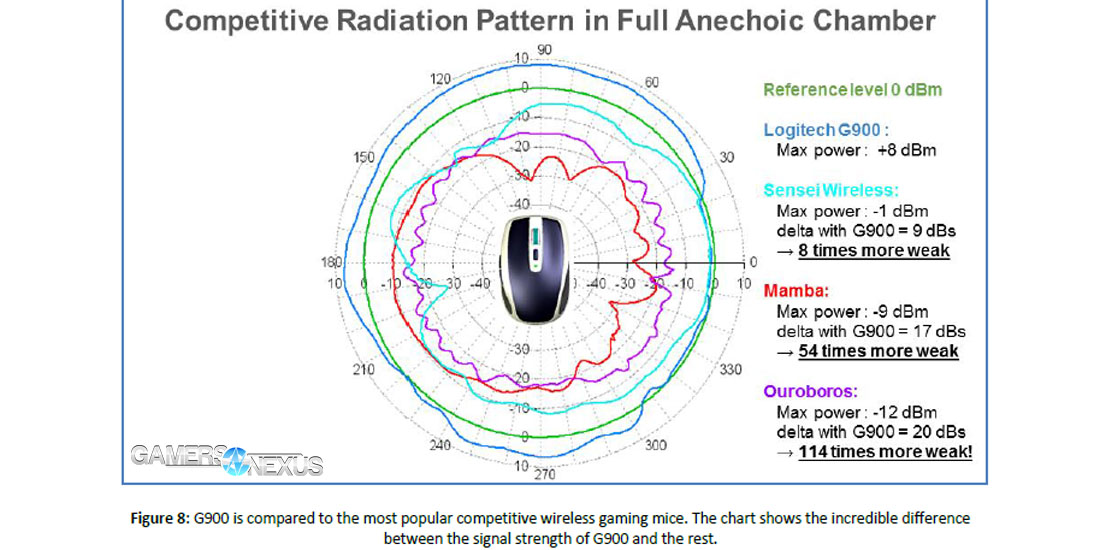
Beyond weight, Logitech's performed impedance/cross-talk testing in anechoic chambers to determine signal strength and radiation patterns. The G900 is advertised as supporting 10m of official line-of-sight use to the system, but was successfully tested up to 120m (line-of-sight, open field test, optimal conditions) maximally. The G900's RF power output is measured at +8dBm (decibel-milliwatts) and maintains a consistent radiation pattern as the mouse transmitter is rotated away from the receiver. Logitech's testing (shown in the images within this article – we cannot validate as we do not have the necessary test environment) shows the SteelSeries Sensei at -1dBm max power signal strength, considerably weaker than the G900. How much that perceptibly impacts most gaming consumers is hard to gauge, but we'll look into it with our extensive and on-going review testing.
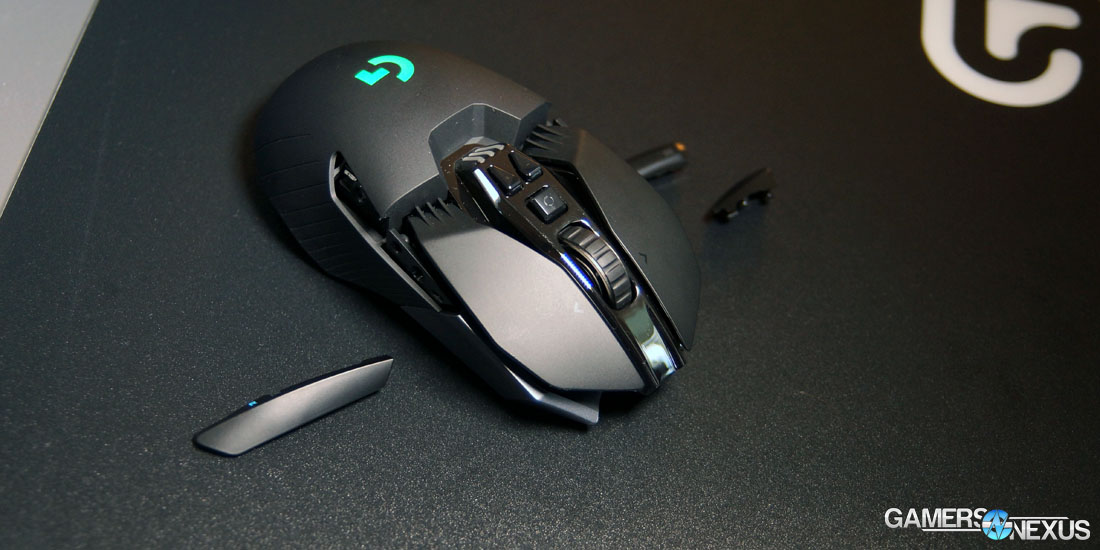
With regard to general durability and 'feel' of the mouse and its switches, Logitech has advanced the G302/G303 metal spring button-tensioning system by removing flexing plastic from the equation. The click action rotates around a metal pivot bar in a way that ensures only the micro-switch actuates, not the entire plastic shell, so there's no sheer application of force and reduction in user fatigue for switch actuation. The LMB + RMB switches are tested individually to ensure the two buttons, per mouse, are within an internally-defined tolerance for the switches.
The Logitech G900 Chaos Spectrum is comparable versus the SteelSeries Sensei, Razer Ouroboros, and Razer Mamba, in terms of nearby and recent competition.
Learn more about the engineering of the G900 Chaos Spectrum mouse in the above video – or wait for our full review to be published within the next week.
Editorial, Host: Steve “Lelldorianx” Burke
A/B-Roll: Keegan “HornetSting” Gallick
Video Editing: Andrew “ColossalCake” Coleman